
.webp)
.webp)


On February 9th, OpenAI started running ads inside ChatGPT. If you're on the Free tier or the new $8/month Go plan in the U.S., some of you may have seen them. They show up below the response, labeled as sponsored. OpenAI says ads don't influence what ChatGPT tells you, and that your conversations stay private from advertisers.
And for now, that's probably true. But what's interesting to me isn't what the ads look like today. It's what they reveal about where this is all going. Because if you've spent any time studying how platforms evolve, how consumer behavior shifts once advertising enters a trusted environment, this is one of the most significant things happening in marketing right now, and almost nobody in the industry is talking about it.
The Environment Just Changed
To understand why this matters, you have to think about what ChatGPT actually is to the people who use it. It's not a search engine. It's not a social feed. It's a conversation. People talk to it the way they'd talk to a trusted advisor. They share business problems, health concerns, career anxiety, relationship issues, financial stress, half-formed ideas at 2 in the morning. They tell it things they wouldn't type into Google because Google feels public and ChatGPT feels private.
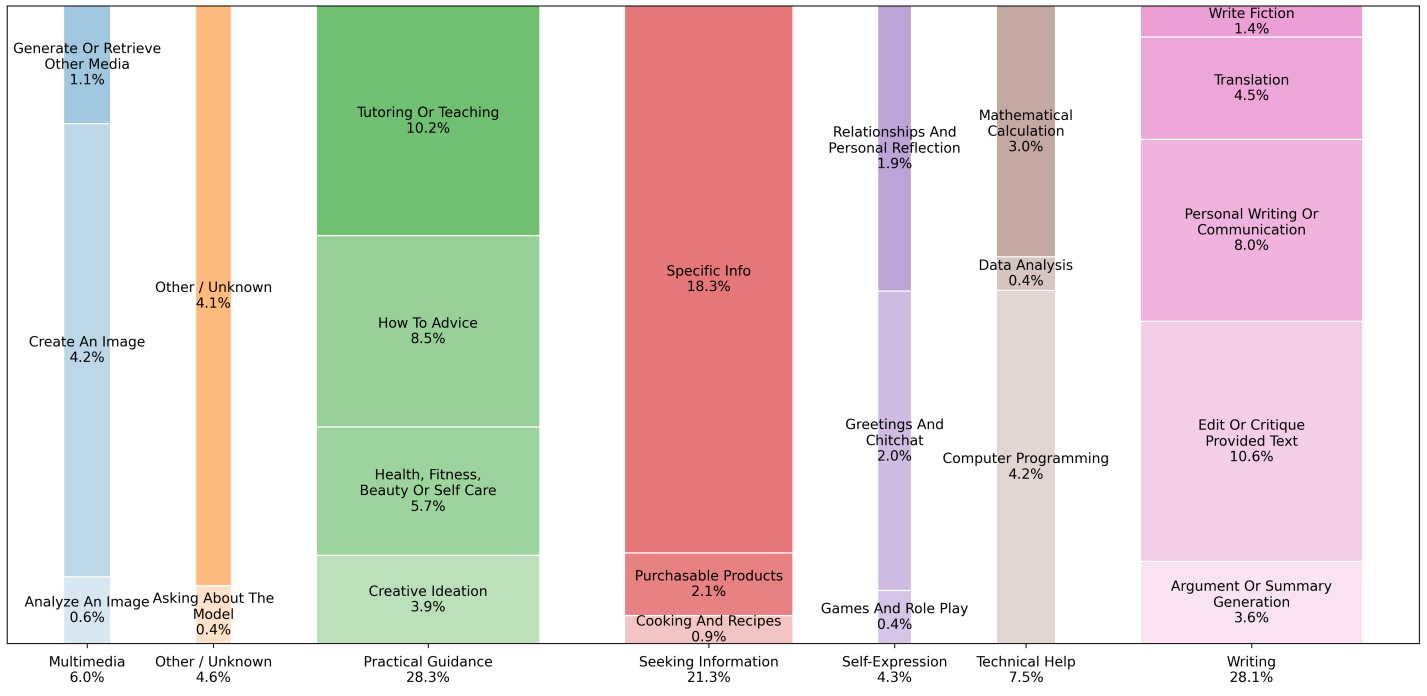
That distinction is everything. And when you look at the actual data on how people use ChatGPT, it becomes even clearer. OpenAI published a research paper with Harvard and Duke that broke down what 700 million users are actually doing inside the platform. And the picture it paints is very interesting.
The vast majority of conversations aren't casual. People are asking for guidance on real decisions. They're working through health questions, career moves, personal writing, how-to advice on things they're actively trying to figure out. They're seeking specific information to inform a choice they're about to make. They're using it for tutoring and teaching, which means they're in a learning mindset. They are open, receptive, trusting the source. Almost none of this is passive browsing. Nearly all of it is active decision-making and seeking answers.
And from an advertising perspective, that's the entire game. These aren't people scrolling a feed with half their attention. These are people leaning in, asking questions, and telling the system exactly what they need and why they need it. Every single one of those use cases represents a moment where someone is psychologically open to a recommendation. Not because they're being tricked. Because they're genuinely looking for help. And that's the most valuable state a consumer can be in from a marketing standpoint.
That's what makes this advertising environment fundamentally different from anything that came before it. Advertising has always been about context, about reaching people at the right moment with the right message. And for decades, the best context advertisers could get was search intent. Someone types "best running shoes" into Google, and you show them a running shoe ad. That's powerful because the intent is declared. But it's also shallow. You know what they searched for. You don't know why. You don't know if they're training for a marathon or trying to get healthy after a rough year. You don't know what's driving the decision underneath the query.
ChatGPT knows. Not because it's spying. Because people volunteer it. They don't just ask "best running shoes." They say "I'm trying to get back in shape after a really sedentary year, I have bad knees, and I need something that won't destroy my joints but will actually make me want to go outside." That's not a keyword. That's a psychological profile. And it's handed over freely, in natural language, inside a relationship the user has come to trust over weeks and months of interaction.
Why a $60 CPM Makes Sense
OpenAI is charging advertisers roughly $60 per thousand impressions with a $200,000 minimum commitment to participate in the beta. That's about 3-6x what Meta charges and significantly higher than most Google Search CPM’s. On the surface, that sounds aggressive for a platform that just started testing. But when you think about it from a consumer psychology perspective, the pricing actually makes sense for the right advertiser.
Traditional digital advertising operates on a spectrum of intent. At the low end, you have display ads and social feeds where users are passively scrolling, not looking for anything in particular. CPMs there are low because the intent is low. You're interrupting someone. At the higher end, you have search advertising where someone has actively typed a query, which means they're already in a decision-making mindset. CPMs are higher because the intent is higher.
ChatGPT sits above both of those. The intent isn't just declared, it's contextualized. The system doesn't just know that someone is looking for a product. It knows the emotional and situational backdrop behind the search. It knows what problem they're trying to solve, what they're worried about, what they've been thinking about for the last three weeks. On top of this, because OpenAI's documentation confirms that memory and ad personalization are enabled by default, the system can reference your stored conversations when determining which ads to show you. That means the targeting isn't just based on what you said five minutes ago. It's based on patterns the system has been quietly putting together with each chat.
That's why the CPM is $60. This is the highest-intent, most context-rich ad surface that has ever existed in digital marketing. And it's still in the early phase. If anything, that number is going up, not down, as the targeting gets more sophisticated and the conversion data starts coming in.
The AI Salesperson
And this is where it starts to get psychologically interesting, and honestly pretty scary.
Think about how this actually plays out. Someone opens ChatGPT and says they have a big job interview next week. They ask for help preparing answers, researching the company, thinking through how to present themselves. The conversation is personal. It's vulnerable. They're sharing real anxiety about a real moment in their life. And ChatGPT is helpful. It gives them solid advice. It helps them prepare. It builds their confidence.
And then, naturally, the conversation touches on first impressions. The system suggests that presentation matters, that showing up polished can shift how you're perceived in the first five minutes. That's not an ad. That's genuinely good advice. But then a Men's Wearhouse-sponsored placement appears below the response. Or that Nordstrom happens to be running a promotion.
And suddenly you're in a different experience than you thought you were in. You came to prepare for an interview. You didn't come to shop. But the system understood, from the full emotional context of your conversation, that you were one helpful suggestion away from becoming a buyer. And the ad didn't feel like an interruption because it arrived inside the flow of advice you were already receiving.
This is fundamentally different from any advertising model we've had before. In traditional advertising, the ad exists outside the relationship. It's a billboard on the highway. A banner on a webpage. A commercial between segments. You know it's there, you know what it's doing, and you have a natural psychological barrier between the ad and your decision-making process.
But when the ad lives inside the conversation, inside the relationship, that barrier dissolves. The recommendation feels like it came from the same source that was just helping you think through your career. And that's not a design flaw. That's the design. OpenAI has already partnered with Shopify, Etsy, and Walmart for in-chat checkout. Their ad formats include "Sponsored Recommendations" and "Native Content Cards," formats built specifically to sit inside the conversational flow rather than beside it.
What we're looking at is the infrastructure for AI-powered salespeople embedded in conversations that 800 million people a week believe are private and neutral. These aren't banner ads with better targeting. These are built-in dialogues designed to guide purchasing behavior from the inside of a trusted interaction. And the people on the receiving end, for the most part, don't even know ads have started yet.
Where Sam Altman Is Steering This Ship
I think this is exactly where Altman is taking OpenAI, and I don't think he's being subtle about it. The company can't survive on subscriptions alone. The computing costs are enormous. The free tier is a massive expense. And the only business model that scales with an 800-million-user base without requiring all of them to pay is advertising.
When Anthropic ran Super Bowl ads this year mocking ChatGPT's move to advertising, Altman's response was telling. He didn't defend the ads as a necessary compromise. He reframed the entire argument. Said Anthropic serves an expensive product to rich people. Said OpenAI needs to bring AI to billions who can't afford subscriptions. He positioned advertising not as a concession but as the mechanism that makes AI accessible to everyone.
That framing matters because it gives OpenAI moral cover to build one of the most powerful advertising platforms in history. If the mission is democratizing access to intelligence, then advertising is the engine that funds it. And once that logic is established, every product decision, every update to memory, every new ad format, every partnership with a retailer, all of it gets justified under the umbrella of making AI free for the world.
The Deeper Shift
Here's what I keep coming back to.
If you look at the history of advertising, there's really one story being told over and over again. And that story is about a boundary getting thinner.
It started obvious. Billboards. TV commercials. You knew exactly where the content ended and the selling began. Then banner ads put the pitch alongside the content, but you could still see the line. Then native advertising made the ad look like editorial, and you had to hunt for the "sponsored" label to know you were being sold to. Then influencer marketing put the ad inside the voice of someone you trusted. Each generation, the boundary got thinner. But it was always there. Some signal, some cue, some moment where your brain could register that what you were looking at was designed to sell you something. And that signal activated a filter. A healthy skepticism. The part of your mind that evaluates a recommendation differently when money is involved.
What ChatGPT ads do is remove that signal entirely.
To be clear, ChatGPT ads do label themselves. They sit below the response, marked as sponsored, visually separated from the answer. The boundary is technically there.
But here's what's different. Every other ad platform puts a label on a recommendation that has no relationship with you. A banner ad doesn't know your situation. A sponsored Instagram post doesn't know what you were thinking about five minutes ago. The label works as a filter in those environments because the ad is coming from a stranger. You see it, you register what it is, and your skepticism kicks in.
Inside ChatGPT, the ad sits below a conversation that already earned your trust. The system already knows your context, your concerns, the emotional backdrop behind your question. It's already been helpful. And when a sponsored recommendation appears directly after advice that genuinely made sense to you, the label says "sponsored" but your brain says "that tracks with everything we were just talking about." The separation is visual. But the psychological connection between the advice and the ad has already been made.
That's the difference. The boundary is still there on the screen. But the dataset behind the ad, the months of stored context, the memory of what you've shared, the understanding of what motivates you, gives it the ability to feel like a natural extension of help you were already receiving. And that's what breaks the barrier down.
And every week, 800 million people are sitting down to have conversations with a system they trust, sharing their problems, their plans, their decisions, with a system that now has both the financial incentive and the psychological infrastructure to turn that trust into transactions. And this is the early version. The obvious version. The one with a label at the bottom and a clear separation between the answer and the ad.
But the economics don't stop here. They never do. The pressure to maximize revenue doesn't lead to more transparency. It leads to less friction. It leads to recommendations that feel so native to the conversation, you stop questioning where they came from. It leads to systems that understand your emotional state well enough to know exactly when you're most likely to say yes, and what to put in front of you when you do.
The real question isn't whether there's a sponsored label on the screen right now. It's what happens when a system that knows your fears, your insecurities, your ambitions, and your weaknesses is financially rewarded for using that understanding to sell. And whether there's a line it won't cross. Or whether the line just slowly moves every quarter to increase profits.
If this resonated, follow along as I explore the rise of AI and its effects on business, marketing, and human behavior. ~ Grant Stahlberg
References
Chatterji, A., Cunningham, T., Deming, D., Hitzig, Z., Ong, C., Shan, C., & Wadman, K. (2025). "How People Use ChatGPT." OpenAI, Duke University, Harvard University. September 2025.https://cdn.openai.com/pdf/a253471f-8260-40c6-a2cc-aa93fe9f142e/economic-research-chatgpt-usage-paper.pdf
Other Readings
The rabbit hole goes deeper.